
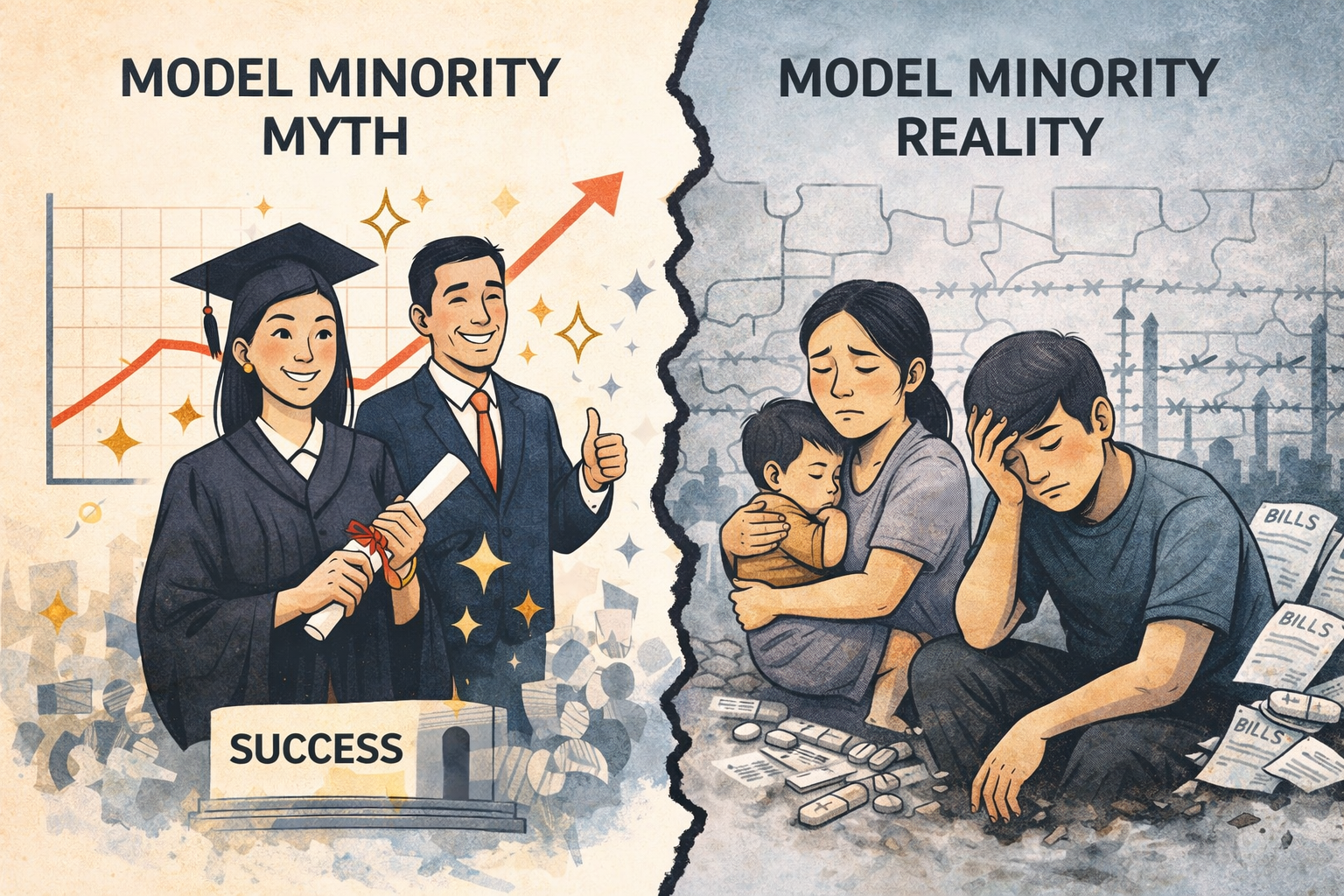
Model Minority Myth vs. Model Minority Reality
The model minority myth is usually delivered as a compliment.
It sounds like praise. Resilience. Quiet success. A reassuring story about how hard work pays off and obstacles can be overcome if you simply keep your head down and try harder.
What it actually asks for is silence, compliance, and the absence of complication.
The Compliment That Wasn’t
Being labeled a “model minority” often feels like being applauded for not making anyone uncomfortable. It rewards those who succeed quietly and punishes those who ask questions too loudly. It suggests that struggle is acceptable only if it remains invisible.
On the surface, the myth sounds generous. Beneath it, the expectations are clear. Be grateful. Be productive. Do not complain. Do not disrupt. Do not remind anyone how you got here.
It is praise with conditions.
Who the Myth Was Really Built For
The model minority myth did not emerge by accident. It took shape during the Civil Rights era, at a time when racial inequality was becoming harder to ignore. Rather than address systemic barriers directly, the myth offered a convenient comparison.
If some communities could succeed, the logic went, then inequality must be a matter of effort rather than structure.
This framing turned entire communities into talking points. It allowed systems to avoid accountability while quietly pitting marginalized groups against one another. Success became a weapon. Failure became a personal flaw. Classism within a class.
The myth was never about celebrating achievement. It was about managing discomfort.
Where Hmong Americans Never Fit
For Hmong Americans, the model minority myth has always been an ill-fitting label.
Grouped broadly under the Asian American category, Hmong experiences were flattened into statistics that never told the full story. High poverty rates, lower college completion, limited access to generational wealth, and the long shadow of war and displacement rarely made it into the narrative.
Trauma does not disappear simply because it is inconvenient to measure.
Yet the myth persisted, offering a simplified story that ignored the reality many Hmong families lived every day. Silence was interpreted as success. Survival was mistaken for thriving.
When Silence Looks Like Success
Many Hmong families learned early that staying quiet was safer than being visible. Drawing attention could invite scrutiny, misunderstanding, or risk. Gratitude became a language of protection. Struggle was handled privately within clans.
Over time, that silence was misread.
Institutions saw compliance and assumed comfort. Policymakers saw low complaint rates and assumed needs were being met. Struggle that remained unspoken became struggle that went unrecognized.
Silence was never proof of ease. It was a survival strategy shaped by history.
The Cost of Being “Good”
The pressure to live up to the model minority myth comes with a cost.
Mental health struggles are often hidden behind expectations of strength. Asking for help feels like failure. Admitting difficulty feels like betrayal of the story everyone else believes.
Success becomes isolating when it requires pretending nothing was ever hard. Because admitting something was hard admits being flawed.
For those who do not fit the myth at all, the cost is different but just as real. Being overlooked means fewer resources, fewer supports, and fewer chances to be seen accurately.
Either way, the myth leaves little room for honesty. It ignores all of the struggles that our forefathers and ancestors fought for, bleed for, and died for. It refuses to acknowledge that they’ve paved the way to our success, an entitlement known only the next generation who groans at hearing old war time stories told repeatedly from an old uncle or grandpa. But to those who lived through it, it was their reality.
Why the Myth Refuses to Go Away
The model minority myth survives because it is useful and convenient.
It allows inequality to persist without confrontation. It reassures those in power that the system works as intended. It turns structural problems into individual responsibilities.
As long as the myth holds, there is no need to ask harder questions about access, opportunity, or fairness. Or a reflection of a truth no one wants to hear.
Convenience has a way of outlasting truth.
Reality Is Messier, and That Matters
Real communities are not slogans. They are layered, contradictory, and shaped by history in uneven ways. Progress does not move at the same speed for everyone, and success does not look the same across generations.
Complexity is not failure. It is reality.
The Hmong American experience does not fit neatly into the model minority myth, and it never needed to. What it needs is space to be understood on its own terms. Without claiming your space, others will fill it for you with a story that you never agreed upon.
A Thought to Sit With
Praise that depends on silence is not praise.
Success that requires invisibility is not success.
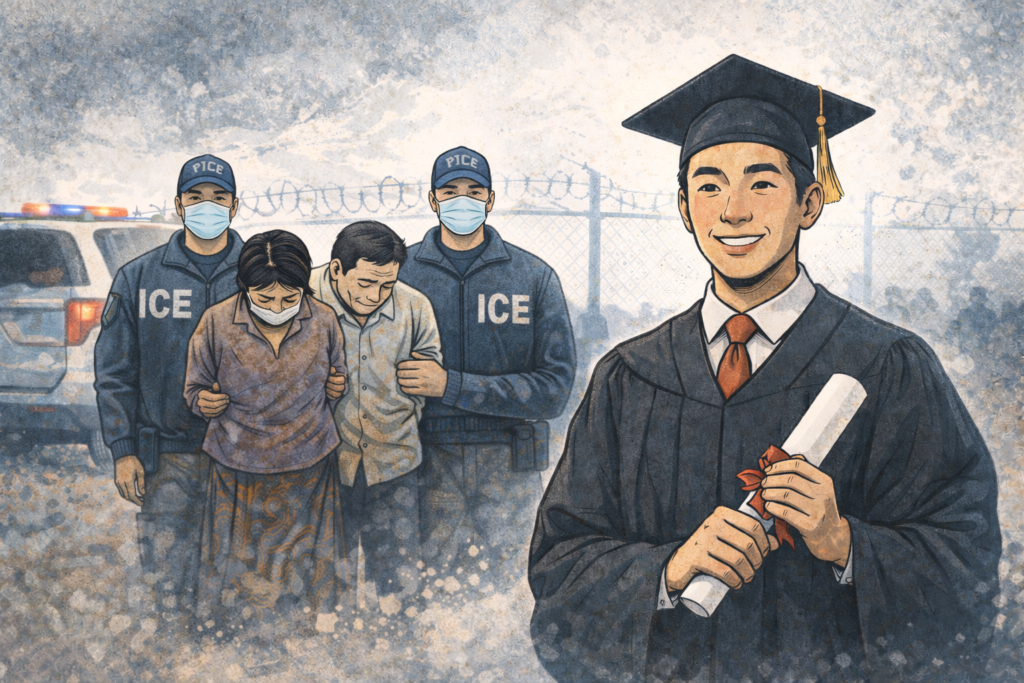
The model minority myth may sound flattering, but it was never designed to tell the truth. And truth, uncomfortable as it may be, is where real understanding begins. There are events and transgressions happening every day, and yet there are those who rather sit idle and wait it out. Citing that since they haven’t caused any trouble, trouble will not find them. On the contrary, being a model minority is the single largest disservice you can do for your Hmong and asian brothers and sisters.
If you won’t speak for them, who shall? When they come for you, and there’s no one left, who shall speak for you?
This is Zaub Qaub.
We are not interested in clean stories.
We are interested in honest ones.
Leave a Reply