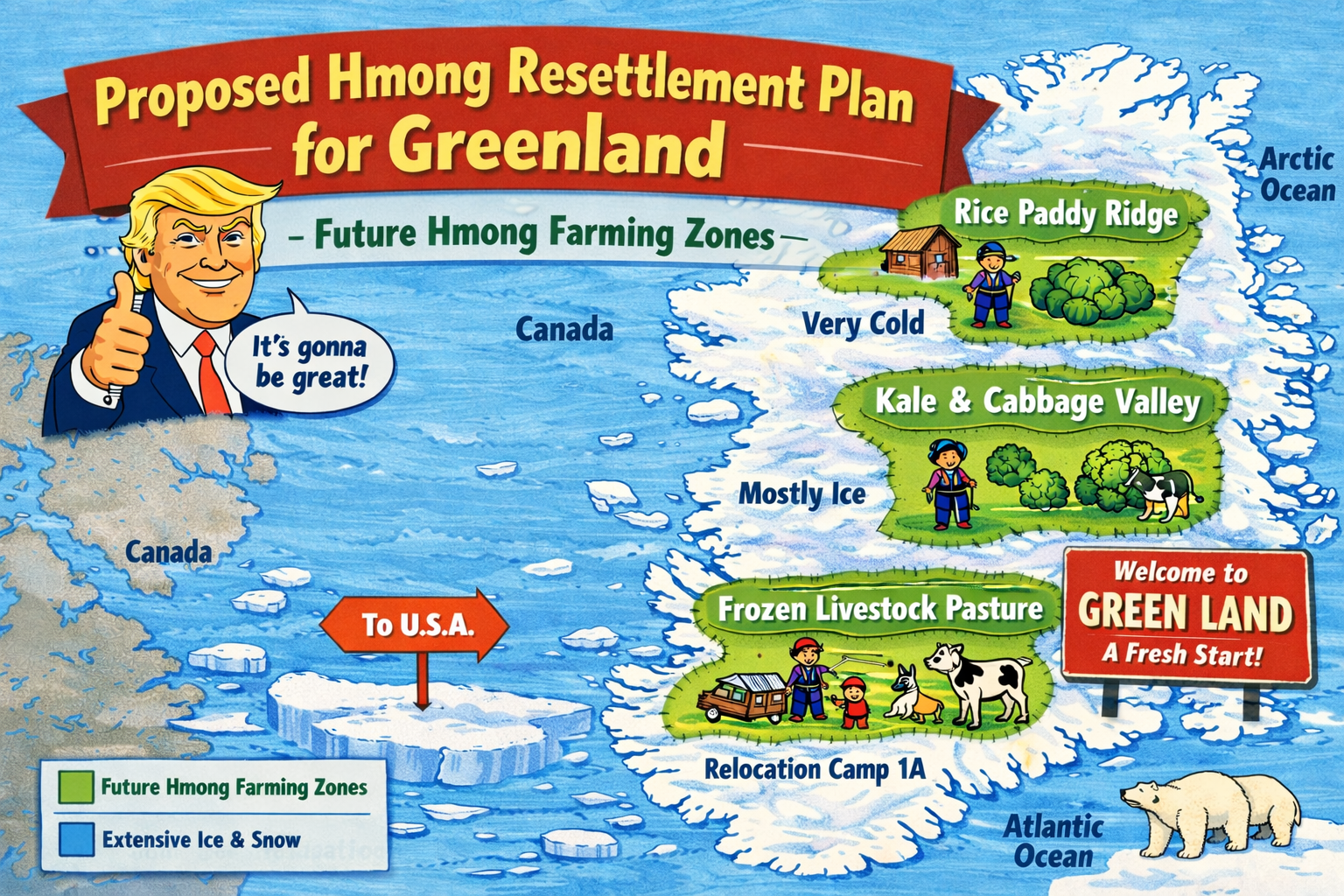
WASHINGTON, D.C. — In what aides are calling a “creative real estate solution to a complicated cultural issue,” former President Donald Trump announced a proposal this week to acquire Green Land for the Hmong people, citing their long history of farming, land stewardship, and “very strong relationship with agriculture, very strong, some of the strongest I’ve ever seen.”
Early reports of the proposal sparked cautious optimism within Hmong communities, where the idea of finally having land to call home—land that is green, fertile, and plentiful—has been a recurring dream since mass displacement from Laos and Thailand decades ago.
That optimism cooled significantly after clarification that the land in question was not metaphorical “green land,” but Greenland—a mostly frozen island covered in ice, snow, and approximately zero rice paddies.
According to sources familiar with the plan, the proposal emerged after advisers reportedly explained that Greenland was “very big, very underutilized,” and technically still land. “It has green in the name,” Trump said, gesturing toward a map. “People love green. Farmers love green.”
Community Reaction: “We Asked for Land, Not a Glacier”
Reaction from Hmong community leaders was measured, cautious, and notably confused.
“We’ve always talked about land as stability—somewhere to plant, to build, to pass down,” said one elder, Chue Pao Hang, reviewing satellite images of Greenland on a borrowed iPad. “This looks more like something you visit briefly and then apologize to your ancestors for. I don’t even own any snow boots.”
Younger Hmong farmers were initially intrigued by the scale of the proposal, noting that Greenland did, in fact, offer plenty of space. That optimism faded after learning that most crops would need to be reclassified as “theoretical” and temperatures can drop below freezing most of the year.
“On paper, it’s land,” said a Midwest-based farmer. “In reality, it’s ice with branding.”
Several families reportedly asked whether the plan included funding for greenhouses, infrastructure, or basic consultation. Officials clarified that the proposal was “still in early phases” and that any logistical concerns would be addressed “in a later administration or different climate” – citing that global warming could improve conditions, if all goes to plan.
Experts Weigh In: “Technically Land, Emotionally Ice”
Policy analysts familiar with refugee resettlement noted that the proposal followed a familiar pattern: bold announcements, symbolic gestures, and an optimistic reliance on future conditions to solve present problems.
“Historically, displaced communities are often offered symbolic solutions instead of structural ones,” said one expert. “This appears to be that—just colder.”
Agricultural consultants hired to evaluate the feasibility of Arctic farming confirmed that while Greenland contains soil, “Are you kidding me? It’s all frozen! Why am I even here?”
“We can grow hope there,” one consultant said. “Food will be harder.”
Program Status Update
According to a brief follow-up issued late Friday, the Greenland Cultural Resettlement & Agricultural Opportunity Initiative has been reclassified from “active proposal” to “long-term concept,” a designation reserved for ideas that test well rhetorically but encounter “unexpected practical considerations.”
Officials confirmed that no land surveys, feasibility studies, or community consultations were scheduled, citing the need to “remain flexible,” and noting that the initiative had already succeeded in “starting an important conversation of justifying the need to acquire Greenland in the first place.”
When asked whether displaced communities would be involved in future discussions about land, housing, or resettlement policy, a spokesperson reiterated that the administration remains committed to “exploring all options,” particularly those that are “large, symbolic, and require minimal follow-up.”
The memo concludes with a reminder that Greenland remains “on the table,” should conditions improve, ice recede, or the definition of farming change.
No further updates are expected.
Leave a Reply